
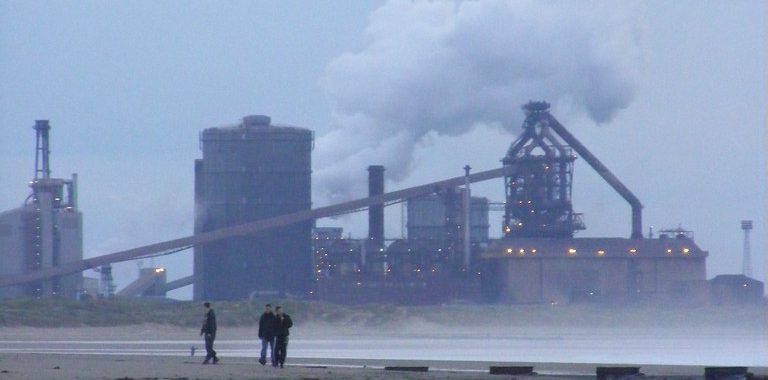
The north of England is an area with a distinct identity dictated by its landscape, history, and culture; cold and rugged whilst also pragmatic and industrious, standing converse to that of the south. George Orwell highlighted this perception in his novel The Road to Wigan Pier, in which it is noted the stereotype that “the Northerner has ‘grit’, he is grim, ‘dour’, plucky, warm-hearted, and democratic; the Southerner is snobbish, effeminate, and lazy,” and also that “the industrial work done in the north is the only ‘real’ work.”[1] This serves to demonstrate that this perception can be seen as not a solely contemporary development, but rather one which dates back some time and has embedded itself within the culture organically over time. As such, more than simply ideological, the discrepancy between the north and south of England is embedded within society and is reflected in the cultural identity and folklore of these areas.
As addressed by Orwell, a vital component of northern English culture is industry; therefore, in discussing the folklore of the north, questions can be raised regarding the impact of industrialisation and deindustrialisation of the landscape on the folklore and culture of the community. How did the rapid scaling of industry, which altered the landscape of the north through the development of factories, mines, and shipyards, expand upon the local folklore? Furthermore, when industry declined just as rapidly in the latter half of the twentieth century, how did the memories and the abandonment of industry in the surrounding environment cause local folklore to evolve further?
It has been stated that, prior to large scale industrialisation, Britain “had a far more intense bond with the landscape: a relationship that codified their existence,” and that as well as physically inhabiting the landscape and utilising the resources and space, they “also inhabited landscapes imaginatively, marking up the world around them with toponyms and tales.”[2] This can be seen reflected in the folklore of the landscape of the time; Jenny (or Jinny) Greenteeth is a folklore creature of the north west who inhabits bodies of water preying on young children,[3] precisely mirrored by the Peg Powler of the north east, who exhibits an identical agenda,[4] while black dogs taking the name of a Padfoot, Gytrash or Skriker all roam the landscape, and boggarts and hobs lurk unseen in the wilderness.[5] Black Dogs, Boggarts, and Hobs are all rooted in a sense of place reflective of the landscape of the time; laden with potential and mystery, the landscape of the north was seen as expansive and enigmatic.
It has been noted that urbanisation saw a decline in reports of creatures such as hobs and boggarts, that “it follows that, as towns and cities grew fast in the nineteenth century, public bogies around the edges of a settlement were sometimes overrun by houses.”[6] Reports of bogies and boggarts seem to be dependent on the liminality and ambiguity of a rural environment, and as urbanity increased alongside industry, the decline of this nature of folklore could be seen to be indirectly proportionate to the increase in urban and industrial folklore.
The impact of industrialisation upon society cannot be understated, as it functioned as a complete restructuring of the way in which many communities and social structures operated; being noted by David Byrne that “industrial systems were more than just systems of economic production. They were also systems of social production and reproduction. In particular, they generated new and distinctive cultural forms.”[7] These cultural forms, such as condensed urban living, mining communities, and factory working can be seen emerging throughout society during the 18th and 19th century.
Mining was perceived as a lifetime vocation, one which descends to your offspring, which resulted in such communities within England forming cloistered societies. Resultingly, it has been noted that “pitmen have always lived in communities; they have associated only among themselves; they have thus acquired habits and ideas peculiar to themselves: even their amusements are hereditary and peculiar.”[8] However, despite each community being generally isolated and retaining its culture internally, migratory paths were formed between communities, through those who relocated between communities in search of more fruitful or secure labour.[9] This migratory pattern allowed for the formation of a society across the region of the north of England and beyond to other industrial hubs of the United Kingdom, which cultivated its own language, culture and folklore through their shared industry, and the impact of the industry on their surroundings.
Mines can be seen to function in the same manner in which the rural outskirts of settlements did, as a space which can be defined by its liminality and ambiguity. An environment determined by both its memory and mystery. This impression is one which can be traced historically; a publication entitled The Unseen World in 1847 describes the nature of mines evocatively, discussing “the dripping of water down the shafts, the tunnelling of distant passages, the rumbling of trams from some freshly explored lode,” suggesting that “all these things may give rise to imaginations far wilder than any which are recorded on the subject.”[10] As a result of this, folklore arose during the industrial era of ghosts and goblins in mines. Two accounts are collated in Notes on the Folk-lore of the Northern Counties of England and the Borders. The first account tells of two miners, one of Cumberland and one of Northumberland; the Cumberland man having been recently dismissed as overseer and replaced by the miner from Northumberland. They worked together in apparent friendship until both perished in a mining accident, believed to have been contrived as an act of revenge by the man from Cumberland. The tale states that “ever after that time, in the place where the two men perished, their voices might be heard high in dispute, the Northumbrian burr being distinctly audible, and also the well-known pronunciation of the treacherous murderer.”[11] A second tale tells of a man haunted by the two spirits, the deaths of whom he is responsible; it was said that “their ghosts haunt him night and day, and he can never remain long in one house, or endure to be alone night or day.”[12]
Outside of spirits and spectres, folktales of mines being haunted by goblins also persisted in these communities. It was purported that northern mines were supposedly haunted by two goblins. One, named Cutty Soams, was spiteful and mischievous. It was stated that “the chief amusement of this capricious but sometimes hard working-bogie, was to cut the rope-traces or soams.”[13] The second conversely, the Bluecap, was industrious; miners would “perceive a light blue flame flicker through the air, and settle on a full coal-tub, which immediately moved towards the rolley way, as though impelled by the sturdiest sinews in the working,” and when the Bluecap was present, he was to be paid for his labour; “if they were a farthing below his due, the indignant Bluecap would not pocket a stiver; if they were a farthing above his due, Bluecap left the surplus where he found it.”[14]
Considering more contemporary tales in the second half of the twentieth century, thematic threads to the supernatural are still maintained. In studying mining heritage in British coal mining communities, Rosemary Power spoke with a miner who relayed tales from the period close to the British mining strikes. He discusses a fatally injured colleague “pleading with his comrades to get him above ground before he died;” he stated that “whatever he saw, he didn’t want to die down there.”[15] Along the same theme of the peculiar and bizarre, the same informant outlined a mining tradition and the resulting folktale stemming from the mining strikes; “miners, he explained, held their sandwiches with two fingers only and threw away the portion covered with coal grime, providing food for the mice that live in every pit. In the absence of the miners’ “piece” or “snap,” the starving mice ate each other until only one giant mouse was left. She lay in wait ready to feast off the first miner back down the pit.”[16] This stands as one tale which is impacted and developed by deindustrialisation.
Industrialisation led to a changing landscape in the north of England. In line with the changing landscape, and development of a smoke-filled skyline crowded with factories and smokestacks, there was also significant pollution in some regions. Teesside for example, following on from two hundred years of being dealing in industrial vocations such as steel, chemical production, and shipbuilding, has been noted to have “widespread legacy pollution and continuing pollution: affecting water, soil, and air.”[17] Resultingly, locals have acquired the nickname of Smoggies, a reference to the perception of poor air quality and a polluted environment. This terminology can be seen utilised in a football chant, arguably a communal activity functioning as contemporary folksongs, which goes “what’s it like to breathe fresh air? What’s it like to breathe fresh air?”[18] However, despite originally utilised as a pejorative term, it is one which has been reclaimed by the locals as a sign of pride in the local community and heritage.[19]
Deindustrialisation of the north of England cannot be discussed without considering the political figure of Margaret Thatcher; in spearheading the deindustrialisation process which in turn left a post-industrial wasteland in its wake, Margaret Thatcher became a mythical figure in her own right, arguably functioning as an effigy to bear the responsibility of the austerity and crash caused by deindustrialisation. Certainly, at the very least, there are many documented examples of the image of Margaret Thatcher being utilised in literal effigies.[20] In 1987, Margaret Thatcher made her way through a derelict wasteland of post-industrial Teesside. Dubbed by the media as her “walk in the wilderness”, this imagery became an iconic visual;[21] a social landmark and a representation of the landscape of a deindustrialised culture.
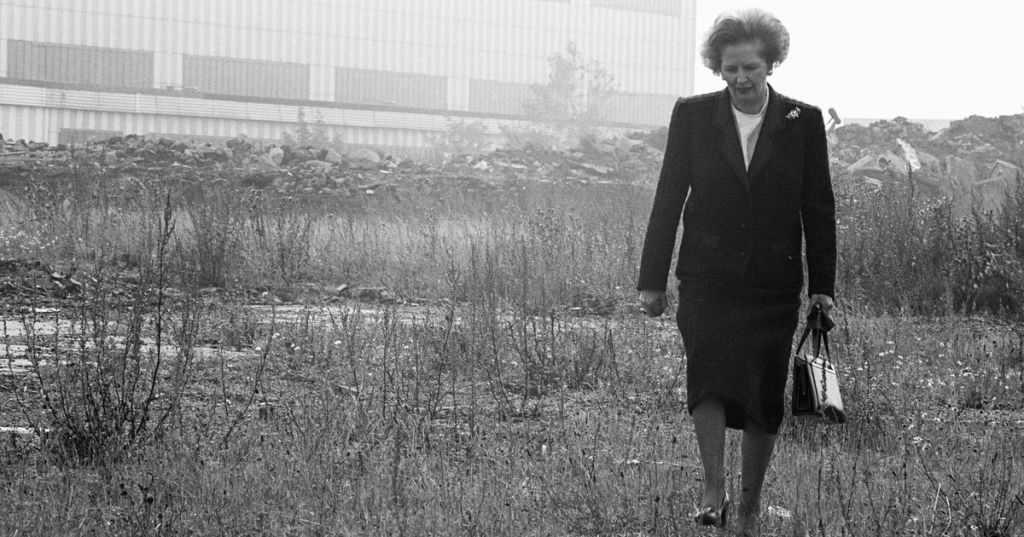
While discussing post-industrial landscape within the Americas, Lachlan Mackinnon stated that “landscapes are anchors of identity and repositories of memory. Within deindustrialized cities and towns, the memory of industrial work is inseparable from the physical site of the workplace among those who have been displaced.”[22] As industry decayed and slowed, and these environments were left abandoned as monuments to a previous way of living, this can be equally appropriately applied to the post-industrial landscape of northern England, where the foundation of an identity, lifestyle, and culture remains through the memories and landscape of industrial heritage.
The sheer scale and rapid decline of deindustrialisation on the north can be seen in the decline of market shares for industrial vocations; for example, shipbuilding in the north-east accounted for 25 percent of the global output in the beginning of the twentieth century but had declined to 0.37 percent by 1974.[23] Some communities, in response to deindustrialisation and as a necessity for the survival of their economy in a post-industrial world, have commodified their heritage and folk culture; it has been noted that, for some communities, “potentially saleable parts of “heritage” can be used as a tool for social and economic regeneration.”[24] Proposals are regularly put forward to redevelop and exploit post-industrial locales in manners which maintain heritage. For example, upon its closure, Teesside Steelworks received proposals for nature reserves, museums and homes, with the intent of preserving the steelworks “as a memorial to all those who worked making the steel and worked in shipbuilding.”[25]
Outside of the scarring of the landscape through intense excavation for mining and the development of monolithic factories, a large impact on the landscape of the north of England which is largely still standing up to the present day is housing. Particularly, colliery houses and villages were developed as a result of the isolation of mining pits as a manner of paternalism on behalf of the workers which, on the one hand, provided an essential resource for the workforce, but conversely also functioned as a manner of control and as a potential weapon to be utilised against a striking workforce.[26] These colliery houses, or pit houses, were generally uniform terraced houses in close proximity to a mining pit, serving as close knit communities entrenched in the folk culture of the surrounding industrial landscape.
Where colliery and industrial communities currently remain, they stand as an iconic archetype of the architecture of the area, as well as a representation of the past culture. To some, however, these environments stand as a motif to form targeted beliefs and stereotypes of the residents. An example of this is the contemporary urban myth of a “Benefits Street,” which stands as a negative belief distributed by politicians and tabloid newspapers, stating that there are communities solely dependent on welfare payments.[27] This stereotype is often applied to former industrial communities, relying on the imagery of post-industrial housing, utilised by tabloid newspapers to produce sensationalist tales of villainous claimants who are exploiting the welfare system, such as the Daily Express, which publishes stories of “work-shy Britons” who “have milked a system that continues to pay out like a limitless cash machine,”[28] and furthermore publishes a “shocking map” which “shows the towns GUZZLING the most benefits cash in Britain,” which could instead be perceived as a map of former industrial communities, such as Knowsley and Walton.[29] Writing on the Benefits Streets and workless communities, Robert MacDonald, Tracy Shildrick and Andy Furlong state that the notion “that there are localities where virtually no-one has employment has become an important myth of our time. It is asserted by senior politicians and it provided the underlying rationale for the TV programme ‘Benefits Street.’”[30] In this paper, the authors argue that rapid deindustrialisation caused the “economic dispossession of the working-class of Britains old industrial centres over the latter third of the 20 Century,”[31] which can be seen to provide the framework and environmental template for these myths. These frameworks are utilised to develop myths in which the working class and non-working individuals are positioned as an alleged antagonist to hard working, tax paying Britons, as a result of the impact of deindustrialisation on these communities.
The degradation of industry led to the abandonment of numerous industrial facilities. Not limited to factories and mines alone, supplementary facilities were also abandoned as a result of the closure of their supporting industries. Railway stations and transportation links such as tunnels and tracks were also left to deteriorate in tandem with their associated industries as the usage requirements for continuous, heavy-duty transport rapidly declined. Further, as these resources are left abandoned, an evolving recreational activity has developed alongside the decay of these industries. Urban exploration is, fundamentally, “the act of entering non-public areas of the built environment for recreational purposes.”[32] The rationale behind this exploration can be variable, whether purely recreational, historical, or ideological, but it is notable that there is a skewed focus on post-industrial locales, with the most popular locations being “industrial sites, ‘other’ sites (which include churches, railways, and schools), and asylums and hospitals.”[33]
Therefore, a question can be raised as to whether Urban Exploration can be considered as a contemporary form of pilgrimage; a form of commemoration to our predecessors and a manner of expanding our understanding of the self through a connection with heritage. Pilgrimage is simultaneously a distinct but nebulous practice, but one that is inherently tied with landscape and place; it has been noted that “place is elemental to pilgrimage, since place is what binds the diversity of the cultural identities so engaged.”[34] Furthermore, whilst individual and independent of traditional religious pilgrimage, urban exploration can be considered to overlap in terms of identifiable elements; these elements of classification has been noted to include a significant distance, motivation to obtain spiritual or material benefit, and a destination which is regarded sacred.[35] Sacred may be considered an incorporeal term, but notably could be seen to envelop elements of heritage and legacy, where those exploring may wish to preserve and commemorate historic memories of industry.
Therefore, at the point in which the post-industrial landscape was embedded in the culture, urban exploration proliferated. Different perceptions and attitudes can be witnessed in viewing examples of urban exploration within the north of England. In exploring Ridge Lane Tunnel, which formerly served Grinkle Mine, two urban explorers narrate the experience with a depth of historic reverence and context but is also reported with a degree of scandal in terms of the elements of danger and intrigue.[36] Additionally, on http://www.28dayslater.co.uk, the primary forum for urban exploration in the United Kingdom, numerous examples are present of explorations of Teesside Steelworks, which, until its recent demolition, stood as a post-industrial monument off the coast of Redcar. User Dempsey states that “Teesside steelworks was an inferno of British industry, and it was right there in front of our eyes, with its raw steel and slag glinting through the palisade fence separating us. Then I reckon, that’s when a strange little affection grew on me.”[37] Separately, another user notes that “large industrial complexes ignite something childish within all of us” and that “its [sic] something that just draws you in and begins to play upon your imagination as you tread closer.”[38] The community speaks romantically, reverentially, and venerably of locales such as this, and the visits are intently documented through written narratives and photography. To view this as a pilgrimage through the lens of the previously discussed criteria, the users of these forum generally treat these places as sacred and travel great distances to visit, once more positioning these locales as almost a sacred pilgrimage destination.
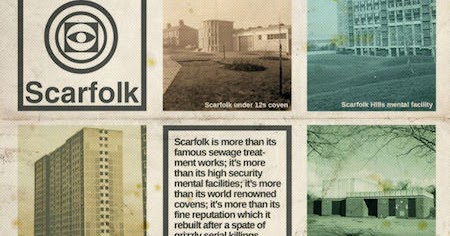
Not simply limited to traditional folktales, culture, and rituals, the impact of deindustrialisation on the perception of northern communities can also be seen in the development of satire and artwork. Scarfolk Council is a satirical series developed by Richard Littler, which presents a series of public service announcements from the fictional town of Scarfolk, a “town in North West England that did not progress beyond 1979.”[39] The Scarfolkproject pulls from the memories of a culture in industrial decline, evoking memories of the winter of discontent and being noted as a look “back to a childhood which was plagued by power cuts, economic strife and the rife of political extremism.”[40] Littler evokes these memories by utilising a sense of time and place through mimicry of the austerity of public information films of the time alongside the usage of imagery influenced by the landscape of a northern industrial hub in decline. This demonstrates the development of a new semiotic language rooted in the post-industrial landscape.
Deindustrialisation is a process which has left scars on the landscape and scars on local communities. However, as seen by these previously discussed locales, folklore surrounding the post-industrial locations perseveres, thrives, and continues to develop following on from the decay of industry. This can be seen as both an active and passive action. It has been questioned whether heritage sites should “through increased focus on shared representational authority, be tasked with healing the wounds of class left behind by the symbolic violence of erasure?”[41] Certainly, the heritage, history, and folklore of the industrious north of England is something which is both actively commemorated and preserved, through heritage sites and redevelopment projects. However, alongside this is folk culture which has been embedded and developed through the perception of abandonment and neglect; urban exploration of forsaken industrial sites and neglected post-industrial communities have allowed for the both the development of new semiotic languages and folk tradition in the post-industrial landscape.
Bibliography:
Brailsford, Poppy-Ann. 2022. ‘Light, traces and identity: The embodied experiences of urban explorers within abandoned spaces’, Durham theses, Durham University.
Byrne, David. 2002. ‘Industrial Culture in a Post-Industrial World: The Case of the North East of England’, City, 6.3.
Dyer, Thomas Firminger Thiselton. 1898. ‘The Ghost World’ (London: Ward & Downey)
Evers, Clifton. 2023. ‘Men’s Polluted Leisure in the Anthropocene: Place Attachment and Well-Being in an Industrial Coastal Setting’, Leisure Sciences.
Fish, Lydia Mary. 1973. ‘The Folklore of Coal Miners of the Northeast of England’ (Indiana: Indiana University)
Henderson, William. 1879. Notes on the Folk-Lore of the Northern Counties of England and the Borders (London: W. Satchell, Peyton and Co).
Hudson, Ray. 1986. ‘Producing an Industrial Wasteland’ in The Geography of De-Industrialisation, ed. by Ron Martin & Bob Rowthorn (Basingstoke: Macmillan Education Ltd)
Leifchild, J. R. 1968. ‘Our Coal and Our Coal-Pits’ (London: Frank Cass and Co.).
MacDonald, Robert, Shildrick, Tracy & Furlong, Andy. 2014. ‘’Benefits Street’ and the Myth of Workless Communities’, Sociological Research Online, 19.3.
Mackinnon, Lachlan. 2019. ‘Coal and Steel, Goodbye to All That: Symbolic Violence and Working-Class Erasure in Postindustrial Landscapes’, Labor: Studies in Working-Class History of the Americas, 16.1.
Nayak, Anoop. 2019. ‘Re-scripting Place: Managing Social Class Stigma in a Former Steel-Making Region’, Antipode, 51.3.
Neale, John Mason. 1847. ‘The Unseen World: Communications with It, Real Or Imaginary, Including Apparitions, Warnings, Haunted Places, Prophecies, Aerial Visions Astrology, Etc’ (London: J. Burns).
Orwell, George. 2014. The Road to Wigan Pier (London: Penguin Books).
Power, Rosemary. 2008. ‘After the Black Gold”: A View of Mining Heritage from Coalfield Areas in Britain’, Folklore, 119.2.
Roberts, Ian. 2007. ‘Collective Representations, Divided Memory and Patterns of Paradox: Mining and Shipbuilding’, Sociological Research Online, 12.6.
Shield, W. P. 1871. ‘Cutty Soams Or the Spectre of the Mine’ (Newcastle-on-Tyne: Samuel Hawthornewaite).
Smith, Alan, Edgar, Robert & Marland, John. 2023. ‘Thomas Hardy and the Folk Horror Tradition’ (New York: Bloomsbury Academic).
Stoddard, Robert. 1997. ‘Defining and Classifying Pilgrimages’, Geography Faculty Publications, 2.
Stones, Samantha. 2016. ‘The value of heritage: urban exploration and the historic environment’, The Historic Environment: Policy & Practice, 7.4.
Terry, Alan & Maddrell, Avril. 2016. ‘Sacred Mobilities: Journeys of Belief and Belonging’ (New York: Routledge).
Vickery, Roy. (1983) ‘Lemna minor and Jenny Greenteeth’, Folklore, 94.2.
Young, Simon. 2020. ‘Public bogies and supernatural landscapes in North-Western England in the 1800s’, Time and Mind, 13.4.
Brown, Jonathan, ‘’Rust in peace’: Former mining village Grimethorpe bids final farewell to Margaret Thatcher as effigy is hanged’, Independent, 18 April 2013, <https://www.independent.co.uk/news/uk/politics/rust-in-peace-former-mining-village-grimethorpe-bids-final-farewell-to-margaret-thatcher-as-effigy-is-hanged-8577251.html> [accessed 17 January 2024]
Dempsey. The Steel Beast – Teeside steelworks (2009-2011), 06 Feburary 2016, <https://www.28dayslater.co.uk/threads/the-steel-beast-teeside-steelworks-2009-2011.101731/> [accessed 17 January 2024]
Jones, Samuel, ‘’The UK’s most dangerous abandoned tunnel’ on Teesside’s doorstep – and it’s not hard to see why’, TeessideLive, 28 March 2021, <https://www.gazettelive.co.uk/news/teesside-news/the-uks-most-dangerous-abandoned-20239189> [accessed 18 January 2024]
KPUrban_. Report – Redcar Blast Furnace, Teesside – Dec 2021, 14 December 2023, <https://www.28dayslater.co.uk/threads/redcar-blast-furnace-teesside-dec-2021.136660/> [accessed 17 January 2024]
Littler, Richard, ‘Scarfolk Council’, <https://scarfolk.blogspot.com> [accessed 7th January 2024]
Perring, Rebecca, ‘REVEALED: Shocking map shows the towns GUZZLING the most benefits cash in Britain’, Daily Express, 6 May 2016, <https://www.express.co.uk/news/uk/667402/Benefits-Britain-map-cash-money-welfare-system-jobseekers> [accessed 14 January 2024]
Ridely, John William, Artist reveals his vision for the former SSI site – what do you think?, TeessideLive, 07 September 2016, <https://www.gazettelive.co.uk/news/teesside-news/artist-reveals-vision-former-ssi-11854152> [accessed 17 January 2024]
Sheldrick, Giles, ‘Benefits Street exposed: The street where 9 out of 10 households are on welfare,’ Daily Express, 6 January 2014, <https://www.express.co.uk/news/uk/452213/Benefits-Street-The-show-exposing-area-where-9-out-of-10-households-are-on-welfare> [accessed 14 January 2024]
Stewart, Heather, ‘The Rocky Road to Regeneration of Post-industrial areas’, Guardian, 03 October 2015, <https://www.theguardian.com/business/2015/oct/03/shops-call-centres-not-answer-for-urban-regeneration-redcar> [accessed 17 January 2024]
[1] George Orwell, The Road to Wigan Pier (London, Penguin Books, 2014), p. 101.
[2] Simon Young, ‘Public bogies and supernatural landscapes in North-Western England in the 1800s’, Time and Mind, 13.4 (2020), p. 401.
[3] Roy Vickery, ‘Lemna minor and Jenny Greenteeth’, Folklore, 94.2 (1983), p. 247.
[4] William Henderson, Notes on the Folk-Lore of the Northern Counties of England and the Borders (London, W. Satchell, Peyton and Co, 1879) p. 265
[5] Young, p. 400.
[6] Young, p. 416.
[7] David Byrne, ‘Industrial Culture in a Post-Industrial World: The Case of the North East of England’, City, 6.3 (2002), p. 279-280.
[8] J. R. Leifchild, ‘Our Coal and Our Coal-Pits’ (London, Frank Cass and Co., 1968), p. 197
[9] Lydia Mary Fish, ‘The Folklore of Coal Miners of the Northeast of England’ (Indiana, Indiana University, 1973), p. 11.
[10] John Mason Neale, ‘The Unseen World: Communications with It, Real Or Imaginary, Including Apparitions, Warnings, Haunted Places, Prophecies, Aerial Visions, Astrology, Etc’ (London, J. Burns, 1847), p. 120
[11] Henderson, p. 322-323
[12] Henderson, p. 323
[13] W. P. Shield, ‘Cutty Soams Or the Spectre of the Mine’ (Newcastle-on-Tyne, Samuel Hawthornewaite, 1871), p. 09
[14] Thomas Firminger Thiselton Dyer, ‘The Ghost World’ (London, Ward & Downey, 1898), p. 264-265
[15] Rosemary Power, ‘After the Black Gold”: A View of Mining Heritage from Coalfield Areas in Britain’, Folklore, 119.2 (2008), p. 175
[16] Power, p.175
[17] Clifton Evers, ‘Men’s Polluted Leisure in the Anthropocene: Place Attachment and Well-Being in an Industrial Coastal Setting’, Leisure Sciences (2023), p. 01.
[18] Anoop Nayak, ‘Re-scripting Place: Managing Social Class Stigma in a Former Steel-Making Region’, Antipode, 51.3 (2019), p. 941
[19] Evers, p. 02.
[20] Jonathan Brown, ‘’Rust in peace’: Former mining village Grimethorpe bids final farewell to Margaret Thatcher as effigy is hanged’, Independent, 18 April 2013, <https://www.independent.co.uk/news/uk/politics/rust-in-peace-former-mining-village-grimethorpe-bids-final-farewell-to-margaret-thatcher-as-effigy-is-hanged-8577251.html> [accessed 17 January 2024]
[21] Heather Stewart, ‘The Rocky Road to Regeneration of Post-industrial areas’, Guardian, 03 October 2015, <https://www.theguardian.com/business/2015/oct/03/shops-call-centres-not-answer-for-urban-regeneration-redcar> [accessed 17 January 2024]
[22] Lachlan Mackinnon, ‘Coal and Steel, Goodbye to All That: Symbolic Violence and Working-Class Erasure
in Postindustrial Landscapes’, Labor: Studies in Working-Class History of the Americas, 16.1 (2019), p. 107
[23] Ray Hudson, ‘Producing an Industrial Wasteland’ in The Geography of De-Industrialisation, ed. by Ron Martin & Bob Rowthorn (Basingstoke, Macmillan Education Ltd, 1986), p. 171.
[24] Power, p. 166-167.
[25] John William Ridely, Artist reveals his vision for the former SSI site – what do you think?, TeessideLive, 07 September 2016, <https://www.gazettelive.co.uk/news/teesside-news/artist-reveals-vision-former-ssi-11854152> [accessed 17 January 2024]
[26] Ian Roberts, ‘Collective Representations, Divided Memory and Patterns of Paradox: Mining and Shipbuilding’, Sociological Research Online, 12.6 (2007), p. 09.
[27] Robert MacDonald, Tracy Shildrick & Andy Furlong, ‘’Benefits Street’ and the Myth of Workless Communities’, Sociological Research Online, 19.3 (2014), p. 263.
[28] Giles Sheldrick, ‘Benefits Street exposed: The street where 9 out of 10 households are on welfare,’ Daily Express, 6 January 2014, <https://www.express.co.uk/news/uk/452213/Benefits-Street-The-show-exposing-area-where-9-out-of-10-households-are-on-welfare> [accessed 14 January 2024]
[29] Rebecca Perring, ‘REVEALED: Shocking map shows the towns GUZZLING the most benefits cash in Britain’, Daily Express, 6 May 2016, <https://www.express.co.uk/news/uk/667402/Benefits-Britain-map-cash-money-welfare-system-jobseekers> [accessed 14 January 2024]
[30] Robert MacDonald, Tracy Shildrick & Andy Furlong, p. 266
[31] Robert MacDonald, Tracy Shildrick & Andy Furlong, p. 267
[32] Samantha Stones, ‘The value of heritage: urban exploration and the historic environment’, The Historic Environment: Policy & Practice, 7.4 (2016), p. 302.
[33] Poppy-Ann Brailsford, ‘Light, traces and identity: The embodied experiences of urban explorers within abandoned spaces’, Durham theses, Durham University (2022), p. 22.
[34] Alan Terry & Avril Maddrell, ‘Sacred Mobilities: Journeys of Belief and Belonging’ (New York, Routledge, 2016), P. 95.
[35] Robert Stoddard, ‘Defining and Classifying Pilgrimages’, Geography Faculty Publications, 2 (1997), p. 43-46.
[36] Samuel Jones, ‘’The UK’s most dangerous abandoned tunnel’ on Teesside’s doorstep – and it’s not hard to see why’, TeessideLive, 28 March 2021, <https://www.gazettelive.co.uk/news/teesside-news/the-uks-most-dangerous-abandoned-20239189>%5Baccessed 18 January 2024]
[37] Dempsey, The Steel Beast – Teeside steelworks (2009-2011), 06 Feburary 2016, <https://www.28dayslater.co.uk/threads/the-steel-beast-teeside-steelworks-2009-2011.101731/>%5Baccessed 17 January 2024]
[38] KPUrban_, Report – Redcar Blast Furnace, Teesside – Dec 2021, 14 December 2023, <https://www.28dayslater.co.uk/threads/redcar-blast-furnace-teesside-dec-2021.136660/> [accessed 17 January 2024]
[39] Richard Littler, ‘Scarfolk Council’, <https://scarfolk.blogspot.com> [accessed 7th January 2024]
[40] Alan G. Smith, Robert Edgar & John Marland, ‘Thomas Hardy and the Folk Horror Tradition’ (New York, Bloomsbury Academic, 2023), p. 17.
[41] McKinnon, p. 110.
 PaperGhoul
Leave a comment