
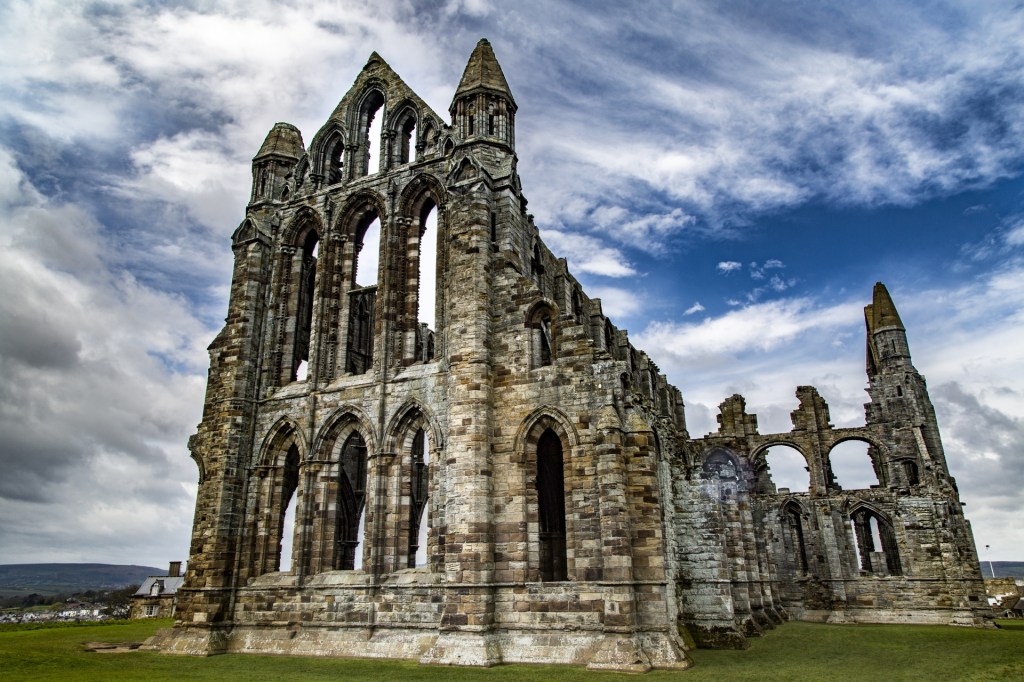
By virtue of its locale and geography alone, Whitby is positioned almost as a folktale caricature; as a cliffside fishing town within the North Yorkshire Moors, Whitby has all the trappings of a mysterious locale, primed for fantastical and weird tales. Surrounded by moorland with little potential for cultivation, cut through by the fast-flowing river Esk, and bordered by a rocky coast and cliff edge,[1] Whitby is entrenched in gothic and romantic characteristics through its isolation and surrounding inhospitality.
Like many coastal towns, Whitby is built around seafaring industries; the industry of Whitby has been described as one of “persistent exploitation, in accordance with the changing needs and ideas of the day, of limited but distinctive natural resources.”[2] One natural resource for which Whitby is reputed up to the present day is the semi-precious gemstone, jet. Primarily mined in Whitby and known its deep black colour, jet has been used in Whitby as an ornament since the Bronze Age, but garnered more attention from the Roman period, and was exploited and distributed from Whitby during this period.[3] Throughout the Victorian era, the popularity of jet increased rapidly, through the increase of costal tourism and the application of jet as commemorative jewellery for mourning periods. The popularity decreased just as rapidly however, in line with the ending of the long mourning period of Queen Victoria.[4]
Prior to jet mining as a prolific industry, Whitby dealt in traditional coastal community and port town industries, such as shipbuilding and fishing, including whaling. These industries continued to be profitable up to the second half of the 19th century, at which point the scarcity of whales and industrialisation elsewhere caused these industries to decline.[5]
However, the 19th Century also saw the advent of tourism as a leisure activity for the middle class. It has been noted that coastal towns such as Whitby began to invest in and focus on the tourism trade during this period.[6]
As a result of this positioning as a tourist destination, Whitby was brought to the forefront of public consciousness through the publication of Bram Stokers Dracula in 1897, which embedded the towns position as a home to the peculiar and unusual. However, the origin of this reputation could be seen to predate this publication; arguably Stoker expanded upon a folkloric footing which was already present as opposed to progenerating a new foundation.
Whitby is dense with folklore both in the town and the surrounding area. Individual tales and aspects of the folklore have different degrees of persistency, with some notorious up to the present day, while some have fallen by the wayside in contemporary folklore in favour of the more prominent and lurid tales.
On the east cliff of Whitby, the remnants of Whitby Abbey overlook the town, once an important religious and economic centre, but, following on from The Reformation and the dissolution of the monasteries, was pillaged for stone and left in ruins.[7] This Abbey proves to be the root of a significant amount of folklore within the area, seemingly stemming not only from a basis in religious belief and the church, but also the gothic and macabre characteristics of a ruined cliffside Abbey. In particular, a significant amount of folklore and folktales derive from the Saxon Abbess, Saint Hilda.
A degree of the culture around Whitby stems from the geology of the area, as with the previously mentioned jet mining. Fossilised remains of ammonites were very common in Whitby, from which derived their own folktales which relate back to the story of Saint Hilda. As told within the folktale, Saint Hilda was charged with founding Whitby Abbey, which necessitated purging the area of an infestation of snakes; this was believed to be carried out through a spell which turned all snakes of Whitby to stone.[8] This folktale posits that the fossilised ammonites found in Whitby were petrified snakes, which in turn embedded itself within the culture. As such, a tradition of forging and affixing snake heads to ammonites began, and the town arms for Whitby displayed three ammonites with snake heads.[9] This tradition is noted in the publication British Curiosities in Nature and Art in 1713.[10]
Ghost tales also persisted around the figure of Saint Hilda. Her figure is claimed to have been witnessed within the remains of the Abbey or at the cliff edge. Other local tales of the supernatural claimed that certain stones of the Abbey would bleed if struck on Holy Thursday.[11] Again, highlighting the pre-existing perception as a region with a reputation for the peculiar, Stoker himself touches upon the folktales of spirits haunting Whitby Abbey in Dracula, stating “it is a most noble ruin, of immense size, and full of beautiful and romantic bits; there is a legend that a white lady is seen in one of the windows.”[12]
Surrounding the Abbey furthermore, another legend is the tale of the submerged bells of Whitby Abbey. The tale suggests that, during the dissolution of the monasteries in the reign of Henry VIII, the bells of Whitby Abbey were to be transported to London and sold. This is carried out to the dismay of the locals, and the bells are loaded onto a boat in the harbour. However, as told in the tale, the vessel “refused to bear away its sacred burden”, and once the ship moved out into the bay “on the beautiful, calm summer evening — it quietly sank beneath the waves; and there under the waters, at a spot within sight of the abbey ruins, the bells still remain, and are still heard occasionally, by the superstitious, rung by invisible hands.”[13]
The legacy of Saint Hilda continues within Whitby and surrounding the Abbey; an article in The Yorkshire Herald in 1900 delves into the folklore surrounding Saint Hilda in the local area, stating that St. Hilda “still dominates Whitby. The curled ammonites found in the alum shale are still to Whitby folk the snakes which she drove from the dwelling, headless because their heads were broken off when they fell over the cliff. The seagulls are St. Hilda’s chickens. The boats and the houses appropriate her name, and even in the new town the last built church is dedicated to her memory,”[14] demonstrating the persistence of her legacy, and the legacy surrounding the ruined Abbey. The quantity of folklore and folktales surrounding Whitby Abbey present the structure as one which is vital and fundamental to culture and community of Whitby throughout its history. This is to such an extent that the dissolution and repression of the monastery did not serve to diminish the influence of the Abbey on local culture, but instead served to expand and increase its impact.
It is well documented that Bram Stoker visited Whitby and took inspiration from the town in the process of writing Dracula. One oft cited example behind the origin and development of the integration of Dracula into Whitby’s environment is the wreckage of the Russian Brigantine Dmitry on Saturday 24th October 1885. Despite being reported in the North-Eastern Daily Gazette only briefly and seemingly as supplementary information alongside a much more detailed account of the local Brigantine Mary and Agnes of Scarborough,[15] the wreckage of Dmitry appears to have embedded itself within local folklore further over time, even prior to becoming the inspiration for the ghost-ship Demeter. In Stokers notes, upon discussing the event with a local coastguard, it was alleged that a large dog emerged from the ship, running up to the churchyard,[16] which developed into the passage featured within Dracula, “the very instant the shore was touched, an immense dog sprang up on deck from below, as if shot up by the concussion, and running forward, jumped from the bow on the sand.”[17] This can be seen to be building upon folktales already prevalent throughout communities in England regarding black dogs. Legends and folktales surrounding black dogscarry many superstitions and beliefs which correlate with the macabre cultural standing of Whitby; black dogs were said to be sighted in areas surrounding death, such as murder sites and graveyards, and were often interpreted as bad omens of impending disaster and doom.[18] Similarly, the associated Gytrash, a spirit in the folklore of northern England said to haunt isolated roadways taking the form of dogs, mules, or horses, featured in Charlotte Brontës Yorkshire set Jane Eyre,[19] further demonstrating this embedded folktale within rural Yorkshire culture.
As in Dracula, the aesthetics and cultures of rural, coastal communities have long been exploited and utilised in storytelling. The nature of the coast has been described as “a space frequently defined for its “inbetweenness,” an unstable amalgam of land and sea, whose tidal comings and goings have helped consolidate its reputation as a liminal space and limit, culturally and environmentally,”[20] and this perception is one which lends communities such as Whitby an air of peculiarity which resonates throughout its folklore and culture. The motif of a grim and dour coastal community, which Whitby is portrayed as in some works, can also be seen in other works throughout the 19th and 20th Century, such as the town of Innsmouth in the works of H.P. Lovecraft.
Onwards toward the late 20th Century and up to the present day, heritage tourism begins to focus on the aesthetic history of the town, with the primary focus on whaling, Whitby Abbey, and Dracula.[21] The manner of the positioning of these aspects can be seen as one which aims to embrace the peculiar and macabre history of the town, and in turn profit from and proliferate the dark stature. For instance, one manner in which whaling is commemorated is by positioning whale bones as an archway atop the Khyber Pass steps.
It can be argued that the story and character Dracula has expanded beyond a simple literary creation and now stands instead as a folk legend, particularly in the local community; the culture of Whitby has been directly impacted as a result of the usage of Whitby as a location within Dracula. Due to the tourism focus on Dracula, Whitby carries out vampire themed tours and a Stoker themed film festival,[22] as well as ghost tours and a goth festival.
Parallels can be drawn between goth culture and the folk culture surrounding both Whitby and Dracula; goth culture emerged in the aftermath of the punk culture of the 1970s and has been defined as representing “a site of creativity with an eclectic range of individuals drawn to its various communities through a common appreciation of myth, make-believe and freedom of expression” and being “bound together by a common interest in alternative spiritualities and for many the iconic mythical figure of the vampire.”[23] From this stemmed an enthusiasm for a Victorian aesthetic within the goth culture, and further subcultures descended from this such as steampunk, a pseudo-Victorian aesthetic identified by science-fiction elements derived from the 19th century and Victorian style technologies.[24] These parallels and the embedded vampiric and Victorian associations within Whitby is most likely what created ideal conditions to profit from goth culture with the Whitby Goth Weekend.
It can be argued that the Whitby Goth Weekend functions as a platform for all the previously discussed folk culture stemming from the Whitby area, as a celebration of the culture and the macabre background of the town. The expansion of goth culture within Whitby, to the point in which the town became a hub for the subculture, most likely stems from the gothic horror prestige of the town. It has been noted that “the growth in Dracula tourism coincided with the vampire turn in the Goth scene, which was partly inspired by the Anne Rice books,” (referring to the Anne Rice series The Vampire Chronicles), and “a product of the shift in the early 1990s Goth scene from a music-based subculture to a fashion-based subculture.”[25] This can be perceived as a shift not only in goth culture, but also as a shift of Dracula and the vampire myth from folktale to folk culture, with its own internal traditions, rituals, and practices.
The Whitby Goth Weekend looks to capitalise on this subculture, and currently has remained a success. The event entails live bands, market stalls, and a range of official and unofficial fringe events.[26] Reaching a national profile, the Goth festival is promoted throughout Goth magazines and goth websites, to an extent in which “the town of Whitby became a Goth destination outside of the weekend(s) of the actual festival – as it had been becoming with the rise of Dracula tourism.”[27] This festival is another manner of capitalisation and exploitation, building on the foundations of the history and folk culture of the town.
It has been outlined that as Whitby turned its back on the sea and associated industry, “Whitby has still a natural endowment to exploit, but an assessment of this endowment, and in particular an assessment of its degree of permanence, lies within the scope of aesthetic rather than historical geography,”[28] suggesting that in lieu of industry and manufacturing potential, Whitby currently exploits and profits from the reputation proliferated by the folklore and gothic aesthetic of the town. This exploitation is not necessarily a negative aspect, as it has allowed Whitby to endure and persist as a coastal tourist resort amid a degradation of English coastal communities and their tourism trade up to the present day. The culture of Whitby is dense with folklore and folk culture, with roots in religion, industry, and literature, from the Roman period through to the Victorian period and up to the present day. This folklore has been forged and transmitted through centuries of formation and reformation, and as a result, Whitby stands as a perfect avenue for the continued persistence of these traditions.
Bibliography:
‘British curiosities in nature and art; exhibiting an account of natural and artificial rareties, both ancient and modern, intermixt with historical and geographical passages’ (London, J.H. for Chr. Coningsby, 1713) <https://historicaltexts.jisc.ac.uk/ecco-0152000900>
“The Gale: Shipwreck at Whitby”, North-Eastern Daily Gazette, 26 October 1885.
“The Peculiar Fascination of Whitby”, Yorkshire Herald, 25 August 1900.
Bone, Kristin L., ‘Location and the Vampire: The Impact of Fictional Stories upon Associated Locations’, in Dracula: An International Perspective, ed. by Marius-Mircea Crisan (London: Palgrave Macmillan, 2017)
Carvalho, Luís Mendonça de, et al, ‘WHITBY JET JEWELS IN THE VICTORIAN AGE,’ Harvard Papers in Botany, 18.2 (2013)
East, William G., ‘The Historical Geography of the Town, Port, and Roads of Whitby’, The Geographical Journal, 80.6 (1932)
Goulding, Christina, Saren, Michael, ‘Performing identity: an analysis of gender expressions at the Whitby goth festival’, Consumption Markets & Culture, 12.1 (2009)
Holt, Robert B., Whitby, Past and Present (London: COPAS & Co, 1890)
Lotzof, Kerry, ‘Snakestones: the myth, magic and science of ammonites’, What on Earth? <https://www.nhm.ac.uk/discover/snakestones-ammonites-myth-magic-science.html> [accessed 3 December 2023]
Lovett, Edward, ‘The Whitby Snake-Ammonite Myth,’ Folklore, 16.3 (1905)
Packham, Jimmy, ‘The gothic coast: Boundaries, belonging, and coastal community in contemporary British fiction, Critique: Studies in Contemporary Fiction’, Critique: Studies in Contemporary Fiction, 60.2 (2019)
Parkinson, Thomas, Yorkshire Legends and Traditions, As Told by Her Ancient Chroniclers, Her Poets, and Journalists (London: E. Stock, 1888)
Pickering, David, Dictionary of Folklore, (London: Cassell, 1999)
Plester, Jeremy, ‘Weatherwatch: 1885 Whitby storm inspired grim scene in Dracula’, Guardian, 5 October 2020. <https://www.theguardian.com/news/2020/oct/05/weatherwatch-1885-whitby-storm-inspired-grim-scene-in-dracula> [accessed 3 December 2023]
Quaile, Sheilagh, ‘”The black dog that worries you at home”: The Black Dog Motif in Modern English Folklore and Literary Culture’, The Great Lakes Journal of Undergraduate History, 1.1 (2013)
Spracklen, Karl, Spracklen, Beverly, ‘The Strange and Spooky Battle over Bats and Black Dresses: The Commodification of Whitby Goth Weekend and the Loss of a Subculture’, Tourist Studies, 14.1
Stoker, Bram, Dracula (Ware: Wordsworth Classics, 1993)
Todd, Malcolm, ‘Jet in Northern Gaul’, Britannia, 23 (1992)
Walton, John K., The English seaside resort: a social history, 1750-1914 (New York: Leicester University Press, 1983)
White, Andrew, A History of Whitby (Stroud: The History Press, 2019)
[1] William G. East, ‘The Historical Geography of the Town, Port, and Roads of Whitby’, The Geographical Journal, 80.6 (1932), p. 484.
[2] East, p. 484.
[3] Malcolm Todd, ‘Jet in Northern Gaul’, Britannia, 23 (1992), p. 246.
[4] Luís Mendonça de Carvalho, et al, ‘WHITBY JET JEWELS IN THE VICTORIAN AGE,’ Harvard Papers in Botany, 18.2 (2013), p. 133–134.
[5] East, p. 496.
[6] John K. Walton, The English seaside resort: a social history, 1750-1914 (New York: Leicester University Press, 1983) p. 48.
[7] Andrew White, A History of Whitby (Stroud: The History Press, 2019) p. 2.
[8] Kerry Lotzof, ‘Snakestones: the myth, magic and science of ammonites’, What on Earth? <https://www.nhm.ac.uk/discover/snakestones-ammonites-myth-magic-science.html> [accessed 3 December 2023]
[9] Edward Lovett, ‘The Whitby Snake-Ammonite Myth,’ Folklore, 16.3 (1905), p. 334.
[10] ‘British curiosities in nature and art; exhibiting an account of natural and artificial rareties, both ancient and modern, intermixt with historical and geographical passages’ (London, J.H. for Chr. Coningsby, 1713), p. 105. <https://historicaltexts.jisc.ac.uk/ecco-0152000900>
[11] Robert B. Holt, Whitby, Past and Present (London: COPAS & Co, 1890) p. 15.
[12] Bram Stoker, Dracula (Ware: Wordsworth Classics, 1993) p. 53.
[13] Thomas Parkinson, Yorkshire Legends and Traditions, As Told by Her Ancient Chroniclers, Her Poets, and Journalists (London: E. Stock, 1888) p. 29.
[14] “The Peculiar Fascination of Whitby”, Yorkshire Herald, 25 August 1900.
[15] “The Gale: Shipwreck at Whitby”, North-Eastern Daily Gazette, 26 October 1885.
[16] Jeremy Plester, “Weatherwatch: 1885 Whitby storm inspired grim scene in Dracula”, Guardian, 5 October 2020. <https://www.theguardian.com/news/2020/oct/05/weatherwatch-1885-whitby-storm-inspired-grim-scene-in-dracula> [accessed 3 December 2023]
[17] Stoker, p. 67.
[18] David Pickering, Dictionary of Folklore, (London: Cassell, 1999) p. 37.
[19] Sheilagh Quaile, ‘”The black dog that worries you at home”: The Black Dog Motif in Modern English Folklore and Literary Culture’, The Great Lakes Journal of Undergraduate History, 1.1 (2013), p. 50.
[20] Jimmy Packham, ‘The gothic coast: Boundaries, belonging, and coastal community in contemporary British fiction, Critique: Studies in Contemporary Fiction’, Critique: Studies in Contemporary Fiction, 60.2 (2019), p. 206.
[21] Karl Spracklen, Beverly Spracklen, ‘The Strange and Spooky Battle over Bats and Black Dresses:
The Commodification of Whitby Goth Weekend and the Loss of a Subculture’, Tourist Studies, 14.1, p. 94.
[22] Kristin L. Bone, ‘Location and the Vampire: The Impact of Fictional Stories upon Associated Locations’, in Dracula: An International Perspective, ed. by Marius-Mircea Crisan (London: Palgrave Macmillan, 2017), p. 184-185.
[23] Christina Goulding & Michael Saren, ‘Performing identity: an analysis of gender expressions at the Whitby goth festival’, Consumption Markets & Culture, 12.1 (2009) p. 28-29.
[24] Spracklen & Spracklen, p. 95.
[25] Spracklen & Spracklen, p. 95.
[26] Spracklen & Spracklen, p. 97.
[27] Spracklen & Spracklen, p. 96.
[28] East, p. 497.
 PaperGhoul
Leave a comment